Kids with more plastic in their bodies did worse on memory tests. Should we be concerned?
Scientists in China tested 5,670 children aged 7 to 10. The more microplastics in their urine, the worse they did on memory tests. The worst part: in a second group of 1,000 children, the kids with more plastic had more trouble sitting still, more worries and more trouble with friends. In Cyprus, scientists found plastic in 100% of the children they tested. Plastic turned up in nearly every child tested. The kids carrying the most did worse on memory and behavior.
5 minute read · Updated · By Aelo Research

Short Summary
In Shenyang, China, scientists tested the urine of 5,670 children aged 7 to 10 for plastic. Each child also did memory tests on a computer. The more plastic in a child's urine, the worse they did.[1]
In a second Shenyang study of 1,000 children, the kids with more plastic had more trouble sitting still, more worries and more trouble with friends. In Ma'anshan, China, 91% of 1,234 kids aged 10 had plastic in their urine. A better diet went with fewer problems.[2, 3]
In Cyprus, plastic turned up in all 29 children tested. Below, we walk through each study: what the scientists did, what they found and why it matters to you.[4]
What is working memory, and why does it matter?
Holding things in mind
Working memory is how we hold things in mind and use them, like the steps of a math problem. Experts group it with focus and self-control. These skills help kids learn to read and do math. Kids also use them to follow and remember the rules in class.[9]
At a glance: the Shenyang memory study
Did kids with more plastic do worse on memory tests?
5,670 children, tested at school age
Yes. In 2025, scientists in Shenyang, China, checked the urine of 5,670 kids aged 7 to 10, from 40 schools. They counted 3 kinds of plastic. Each child also did memory tasks on a computer.[1]
More plastic, weaker memory
Kids with more plastic in their urine did worse on the memory tasks. The more plastic, the lower the scores.[1]
Did kids with more plastic have more behavior problems?
More trouble sitting still in 1,000 children
Yes. A second team in Shenyang checked the urine of 1,000 kids aged 6 to 9, from 40 schools. Kids with more plastic had more trouble sitting still and paying attention. They had more worries, more trouble with temper and rules, and more trouble with friends. They were also less kind and helpful. Boys and girls showed the same pattern.[2]
91% of 1,234 ten-year-olds
In Ma'anshan, China, a team tested the urine of 1,234 kids, all aged 10. A laser checked which plastic each particle was. 91% had plastic. In boys, one plastic went with more rule-breaking.[3]
Does a healthy diet help?
Fewer problems with a better diet
In Ma'anshan, kids who ate a Mediterranean diet had fewer problems. In kids with less healthy diets, nylon plastic went with more worry, more trouble with friends and more rule-breaking.[3]
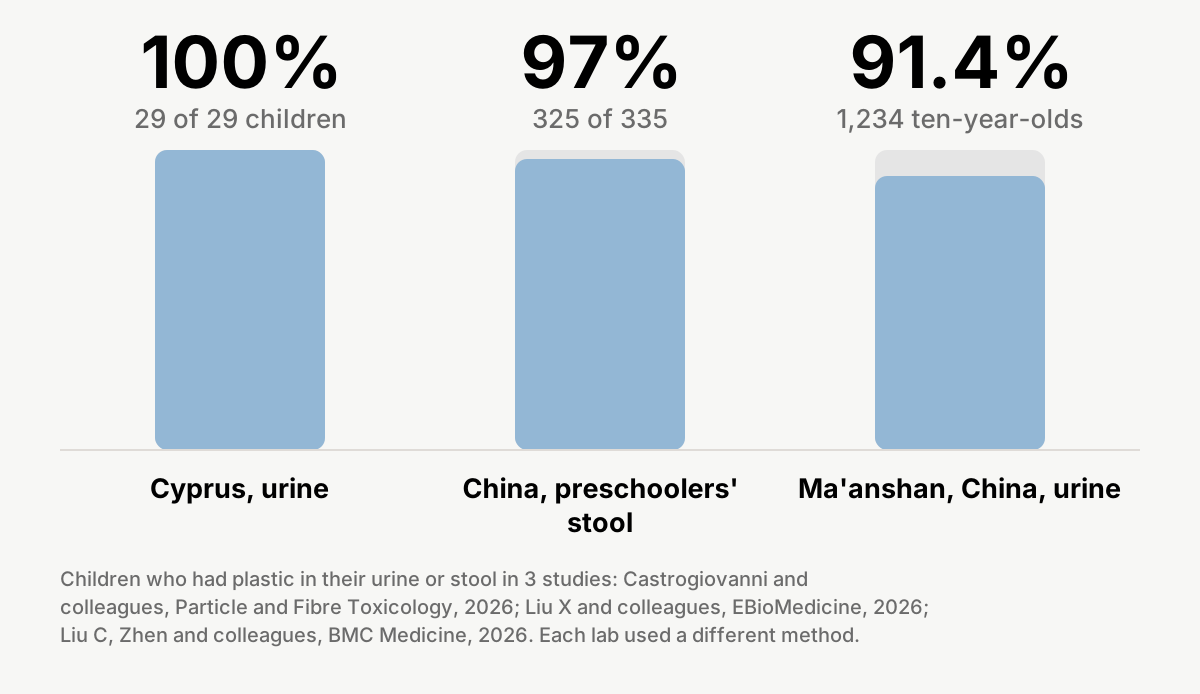
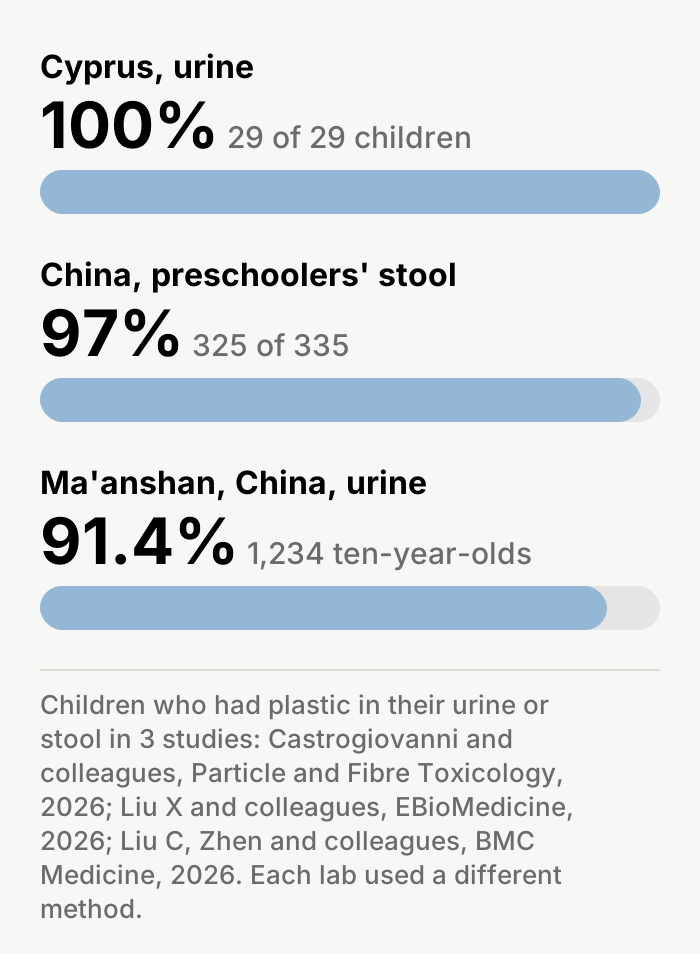
How many children had plastic in their bodies?[3, 4, 5]
How does plastic get into children?
Mostly through what we eat and drink
Scientists think most plastic gets into the body through the gut, from what we eat and drink.[6]
97% of preschoolers
In 3 cities in China, scientists tested the stool of 335 preschoolers, aged 3 to 6. 325 of them had plastic in it. That plastic had passed through their gut.[5]
Not from fingers in mouths
In Cyprus, the children's plastic levels did not track how often they put their hands in their mouths.[4]
Baby bottles shed plastic
New baby bottles shed plastic into hot water. We walk through that study in our fertility article.[7]
Is plastic in adult brains?
In every adult brain tested
Plastic has also turned up in adult brains. In New Mexico, every brain sample a team tested held it. We walk through that study in our brain article.[8]
How did they find the plastic?
Each lab used a different tool, so their counts can't be compared with each other. In Ma'anshan, a laser checked which plastic each particle was. In Cyprus, a strong microscope found the tiniest bits. A heat test told the plastics apart. Both Shenyang teams counted the bits under a microscope. The preschool study used a heat test to measure each kind of plastic.[1, 2, 3, 4, 5]
What this proves, and what it doesn't
What these studies show
- In 5,670 children, more plastic in urine went with worse working memory, and the more plastic, the lower the scores.[1]
- In 1,000 children, more plastic went with more trouble sitting still, more worries and more trouble with temper and friends.[2]
- Plastic turned up in nearly every child tested. That was 29 of 29 kids in Cyprus, 325 of 335 young kids in China and 91% of 1,234 kids aged 10.[3, 4, 5]
- Kids with better diets had fewer problems.[3]
What these studies did not prove
- That plastic causes memory or behavior problems. Each study measured plastic and the children at one point in time, which shows a link, not a cause.[1, 2]
- That the results hold everywhere. The 3 big studies were all in China.[1, 2, 3]
- That every bit counted was plastic. Both Shenyang teams counted the bits under a microscope. Both papers say a lab test is needed to be sure what each bit is made of.[1, 2]
- How much plastic a child carries. Each lab used a different method, and the counts don't match.[4]
- Where each child's plastic came from. These studies measured plastic in urine and stool, not in food or water.[1, 5]
- That a better diet lowers the plastic or its effects. The diet finding was a link, not a test.[3]
Questions readers are asking
Can microplastics affect a child's brain?
In 5,670 kids, those with more plastic in their urine did worse on memory tests. The more plastic, the lower the scores.[1]
Do children have microplastics in their bodies?
Nearly all kids tested do. In Cyprus, 29 of 29 kids had plastic in their urine. In China, 325 of 335 preschoolers had it in their stool.[4, 5]
Are microplastics linked to ADHD?
No study here tested for ADHD. In 1,000 kids, those with more plastic had more trouble sitting still and paying attention.[2]
How do children take in microplastics?
Mostly through what they eat and drink, scientists think. New baby bottles shed plastic into hot water.[6, 7]
Can a healthy diet help?
In one study of 1,234 ten-year-olds, kids who ate a Mediterranean diet had fewer problems, and the links with plastic were weaker.[3]
About Aelo
Lab-tested on particles down to 0.5 microns (500 nanometers). Aelo's products are not connected to this research.
The technical record
Everything above is the story. Everything below is the paperwork: the exact statistics as published, the study’s own fine print, and the parts only a methods reviewer will want.
The numbers, exactly as published
| 5,670 children, tested at school age | 5,670 children from 40 schools, 2022 to 2023; morning urine. Polyamide (nylon), polypropylene and PVC counted under an optical microscope; median 5 particles per 100 mL each, total 15. Two-back and three-back computer tasks (d′, higher is better). Linear mixed-effects models with school as a random effect, adjusted for age, BMI, sex, parental education, income, tobacco smoke at home and breastfeeding; β per IQR. |
|---|---|
| More plastic, weaker memory | Working memory (median 246 d′): polyamide β −9.98 (95% CI −13.75 to −6.20), polypropylene −4.95 (−8.70 to −1.20), total −7.42 (−10.27 to −4.56); PVC not significant. Harder task: polypropylene −1.77, PVC −2.05, total −2.25. BKMR: a dose-dependent negative association. Quantile g-computation: working memory −9.80. |
| More trouble sitting still in 1,000 children | Parent-completed Strengths and Difficulties Questionnaire (ages 4 to 17 version); mixed-effect negative binomial models with school as a random effect, adjusted; per IQR of total microplastics: emotional 0.128, hyperactivity 0.168, peer problems 0.206, prosocial −0.125, total difficulties 0.177. Conduct problems: strongest for polypropylene, 0.231 (95% CI 0.140 to 0.323). Median total 9 particles per 100 mL. December 2022 to May 2023. |
| 91% of 1,234 ten-year-olds | Laser direct infrared (LDIR); detection 91.41%; median 250 particles per mL. Boys: PTFE and rule-breaking β 0.165 (95% CI 0.026 to 0.305), externalizing problems β 0.249. |
| Fewer problems with a better diet | KIDMED adherence and Total Problems β −0.383 (95% CI −0.620 to −0.146). Low or moderate adherence group: polyamide and Total Problems β 0.244, anxious/depressed 0.126, social problems 0.199, rule-breaking 0.156, externalizing 0.246. |
| 97% of preschoolers | Xiamen 98, Shanghai 116, Nanjing 121; October 2022 to March 2023; 8 types by heat test (Py-GC/MS); PVC in 94.6%; median 212.1 µg/g dry weight. |
The fine print: the Shenyang memory study
Design: a cross-sectional study of 5,670 primary school children aged 7 to 10 from 40 schools in Shenyang, China, 2022 to 2023. Morning urine (8 to 10 a.m.) was filtered and the particles counted under an optical microscope at 100x, 3 times per filter, with SEM-EDS and a rose Bengal stain to separate plastic from biological debris; a water blank showed no contamination. The authors write that definitive confirmation of the plastic types needs FT-IR, Raman or Py-GC-MS, which was beyond the scope of the study. Working memory: two-back and three-back computer tasks (d′); attention: reaction-time variability (HRT-SE). Linear mixed-effects models with school as a random effect, adjusted for age, BMI, sex, parental education, household income, tobacco smoke at home and breastfeeding; BKMR, gQWS and quantile g-computation for the mixture.[1]
Results per IQR: polyamide β −9.98, polypropylene −4.95 and total −7.42 on working memory (median 246 d′, so about 10 points, or 4%, per IQR of polyamide); PVC was not significant there. Harder task: polypropylene −1.77, PVC −2.05, total −2.25. BKMR: estimates above zero in the lower quartiles and below the null beyond about the 0.4 quantile (a dose-dependent decline); no consistent pattern for attention. g-comp: −9.80 and −2.35; gQWS was not significant. The limits the authors state are one city, one point in time, and no data on diet, air pollution, sleep, plastic-product use or screen time.[1]
Attention: total microplastics β −1.83 (p = 0.04) on reaction-time variability. A negative β would mean less variability, yet the paper describes it as more inattention, and BKMR found no consistent link, so this review leaves attention out of the story.[1]
The fine print: the Shenyang behavior study
1,000 children aged 6 to 9 (mean 8.5) from 40 schools across Shenyang, December 2022 to May 2023. Particles in urine were counted under an optical microscope at 100x, with SEM-EDS and a rose Bengal stain; the paper says conclusive confirmation of each particle's chemistry needs spectroscopy and was outside its aims. Median total 9 particles per 100 mL. Parents filled in the Strengths and Difficulties Questionnaire (Chinese version, ages 4 to 17). In mixed-effect negative binomial models adjusted for BMI, age, parental education, income, gender, tobacco smoke at home and breastfeeding, more plastic went with higher emotional, conduct, hyperactivity and peer-problem scores and lower prosocial scores; boys and girls did not differ. The abstract credits the conduct estimate (0.231) to total microplastics; the text credits it to polypropylene. The authors note the parent-reported questions and residual confounding.[2]
The fine print: the Ma'anshan study
1,234 ten-year-olds in the Ma'anshan Birth Cohort, Anhui, China. Urine was tested by laser direct infrared (LDIR): plastic in 91.41%, median 250 particles per mL. Behavior was measured with the Child Behavior Checklist and diet with the KIDMED Mediterranean diet index. In boys, PTFE went with rule-breaking (β 0.165) and externalizing problems (β 0.249). Higher diet adherence went with lower Total Problems (β −0.383). With low or moderate adherence, polyamide went with Total Problems (β 0.244) and with anxious/depressed, social problems, rule-breaking and externalizing scores. Published early (1 September 2026); read at abstract level.[3]
The fine print: the Cyprus and preschool studies
Cyprus (2026): first-morning urine from 29 primary school children, tested by scanning electron microscopy with energy-dispersive X-ray analysis for particles under 10 µm, with Py-GC/MS for polymer types. Particles were found in all samples (median 1,217 per mL; range 393 to 8,050), 0.88 to 3.44 µm across, mainly polyethylene and polypropylene. No link with BMI-for-age or hand-to-mouth behavior.[4]
Preschoolers (2026): stool from 335 children aged 3 to 6 in Xiamen, Shanghai and Nanjing, October 2022 to March 2023, tested by Py-GC/MS. Plastic in 325 of 335 (97.0%), 8 types; PVC most common (94.6%); median 212.1 µg/g dry weight.[5]
The fine print: the plain-language facts
Working memory: the Center on the Developing Child at Harvard University describes executive function as being able to "focus, hold, and work with information in mind", including working memory, attention and inhibitory control, skills that "contribute to early reading and math achievement". The Strengths and Difficulties Questionnaire is "a brief behavioural screening questionnaire about 2-17 year olds" with scales for emotional symptoms, conduct problems, hyperactivity/inattention, peer relationship problems and prosocial behaviour.[9, 10]
The fine print: funding, conflicts and how we checked
Every number on this page was checked against the study's full text, or its abstract where noted, and is recorded in a fact sheet for each study. Aelo received no funding for this review and has no financial relationship with any study, its authors or its funders.[4, 5]
Sources
- Zheng D, Wang D, Zhang S, Liu Y, Xi Q, Weng Y. Impact of urinary microplastic exposure on cognitive function in primary school children. Ecotoxicol Environ Saf. 2025;302:118532. doi:10.1016/j.ecoenv.2025.118532. PMID 40580637. Open access. Impact of urinary microplastic exposure on cognitive function in primary school children
- Dong L, Li X, Zhang Y, Liu B, Zhang X, Yang L. Urinary microplastic contaminants in primary school children: associations with behavioral development. Ecotoxicol Environ Saf. 2025;295:118097. doi:10.1016/j.ecoenv.2025.118097. PMID 40179802. Open access. "Urinary microplastic contaminants in primary school children: Associations with behavioral development"
- Liu C, Zhen H, Wang X, Sun D, Tong J, Gao G, Wu X, Gan H, Yan S, Tao F, Huang K. Impact of microplastic exposure on emotional and behavioral development in school-aged children: the moderating role of diet. BMC Med. 2026. doi:10.1186/s12916-026-05185-0. Open access (CC BY-NC-ND 4.0); early access, read at abstract level. "Impact of microplastic exposure on emotional and behavioral development in school-aged children: the moderating role of diet"
- Castrogiovanni M, Rapisarda P, Oliveri Conti G, Carroccio SC, Riccobene PM, Ferrante M, Makris KC. Plastic signatures in childhood: first evidence of urinary micro- and nanoplastics in primary school children from Cyprus. Part Fibre Toxicol. 2026;23:42. doi:10.1186/s12989-026-00694-5. PMID 42400059. PMCID PMC13617907. "Plastic signatures in childhood: first evidence of urinary micro- and nanoplastics in primary school children from Cyprus"
- Liu X, Cai H, Zhao L, Ke D, Xu X, Li J, Yu J, Shen Y, Zhu L, Jin Y, Zhang M, Liu S, Du J, Zheng J, Dong R. Microplastic-associated gut microbial profile and antibiotic resistance in preschool children: a multicentre cross-sectional study in China. EBioMedicine. 2026;125:106177. doi:10.1016/j.ebiom.2026.106177. PMID 41713162. PMCID PMC12933616. "Microplastic-associated gut microbial profile and antibiotic resistance in preschool children: a multicentre cross-sectional study in China"
- Leonard SVL, Liddle CR, Atherall CA, Chapman E, Watkins M, Calaminus SDJ, Rotchell JM. Microplastics in human blood: polymer types, concentrations and characterisation using μFTIR. Environ Int. 2024;188:108751. doi:10.1016/j.envint.2024.108751. Open access (CC BY 4.0). "Microplastics in human blood: polymer types, concentrations and characterisation using μFTIR"
- Li D, Shi Y, Yang L, Xiao L, Kehoe DK, Gun'ko YK, Boland JJ, Wang JJ. Microplastic release from the degradation of polypropylene feeding bottles during infant formula preparation. Nat Food. 2020;1:746-754. doi:10.1038/s43016-020-00171-y. Open access (green). Microplastic release from the degradation of polypropylene feeding bottles during infant formula preparation
- Nihart AJ, Garcia MA, El Hayek E, et al. Bioaccumulation of microplastics in decedent human brains. Nat Med. 2025;31:1114-1119. doi:10.1038/s41591-024-03453-1. PMID 39901044. PMCID PMC12003191. Bioaccumulation of microplastics in decedent human brains
- Center on the Developing Child at Harvard University. What is executive function? And how does it relate to child development? What Is Executive Function? And How Does It Relate to Child Development?
- SDQ Info. What is the SDQ? Strengths and Difficulties Questionnaire. What is the SDQ?