Microplastics found in semen and placentas. What does it mean for fertility?
100% of men tested at fertility clinics in China had plastic in their semen, and men carrying more kinds of plastic were more likely to have low sperm counts. 100% of human testicles tested in New Mexico had plastic in them, nearly 3 times as much as the dog testicles in the same study. In the dogs, certain plastics went with smaller testicles for their body weight. In a study of 1,750 births in China, babies with more plastic in the placenta were born smaller. In lab mice, plastic in their water damaged sperm and lowered testosterone, and in people, the men carrying the most kinds of plastic were the most likely to have low sperm counts. Where is the plastic coming from? And what can you do about it?
7 minute read · Updated · By Aelo Research

Short Summary
Six studies looked at plastic where new life starts. In China, 100 of 100 men tested at fertility clinics had plastic in their semen. Men carrying more kinds of plastic were more likely to have a low sperm count. In New Mexico, 23 of 23 human testicles held plastic, nearly 3 times as much as the dog testicles tested in the same study.[1, 2]
In China, a study of 1,750 mother-baby pairs found that babies with more plastic in the placenta were born smaller: lower birth weight, shorter length and smaller head measurements.[7] An earlier, smaller study in Tehran found plastic in 13 of 13 placentas from babies who grew too slowly, against 3 of 30 from normal pregnancies. We could read only its short public summary (the abstract), because the full paper is behind a paywall.[3]
In Nanjing, plastic in the drinking water left male mice with fewer healthy sperm and less testosterone. The mice show what plastic did when it was the only change. The men show the same direction: more kinds of plastic, more low sperm counts. And one study caught plastic on its way into a drink: in Dublin, new baby bottles shed plastic into hot water. Below, we walk through each study: what the scientists did, what they found and why it matters to you.[4, 5, 8]
Do animal studies matter for humans?
Yes. In Nanjing, male mice drank plastic in their water for 6 months. It left them with fewer healthy sperm and less testosterone than mice on clean water. Household dogs had plastic in 47 of 47 testicles tested. Men at fertility clinics had it in 100 of 100 semen samples. The mice show what plastic did when it was the only change. The dogs and the men show it is there.[1, 2, 8]
Read our full article: Do animal studies matter for humans?
At a glance: the 6 studies
Was plastic in the men's semen?
100 of 100
Yes. At 3 hospitals in China, 113 men who had tried for a baby for over a year gave semen and urine. For 100 of them, both samples were tested for 8 kinds of plastic. All 100 had plastic in both.[1]
More kinds, more low counts
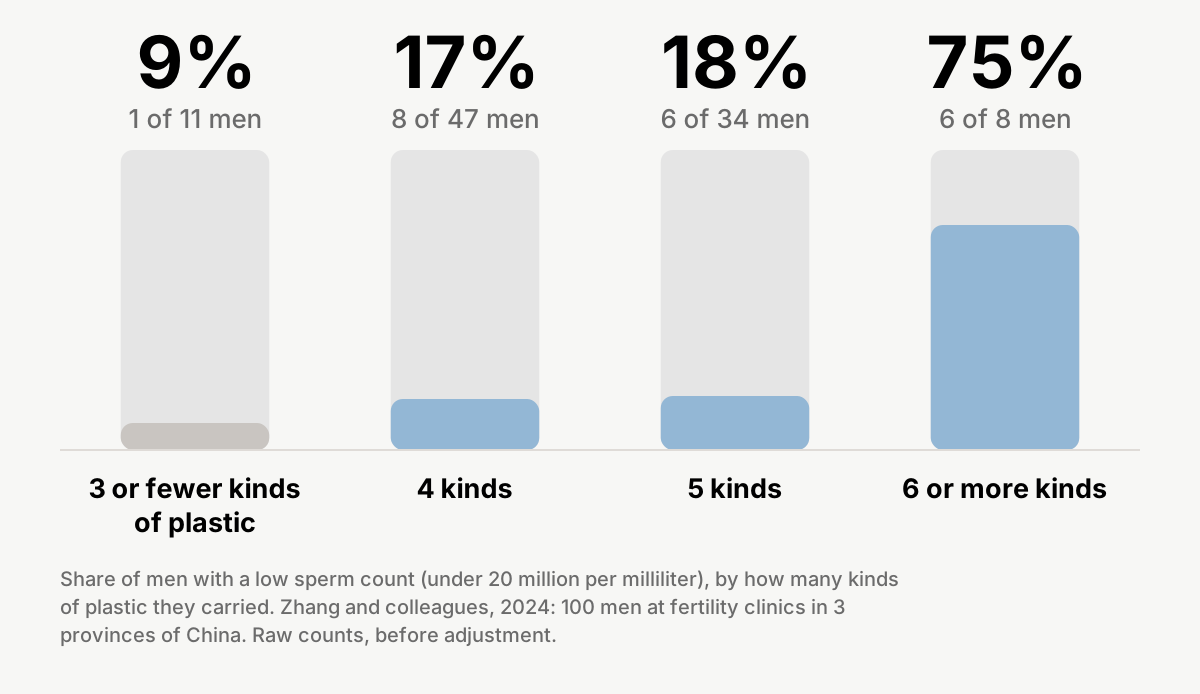
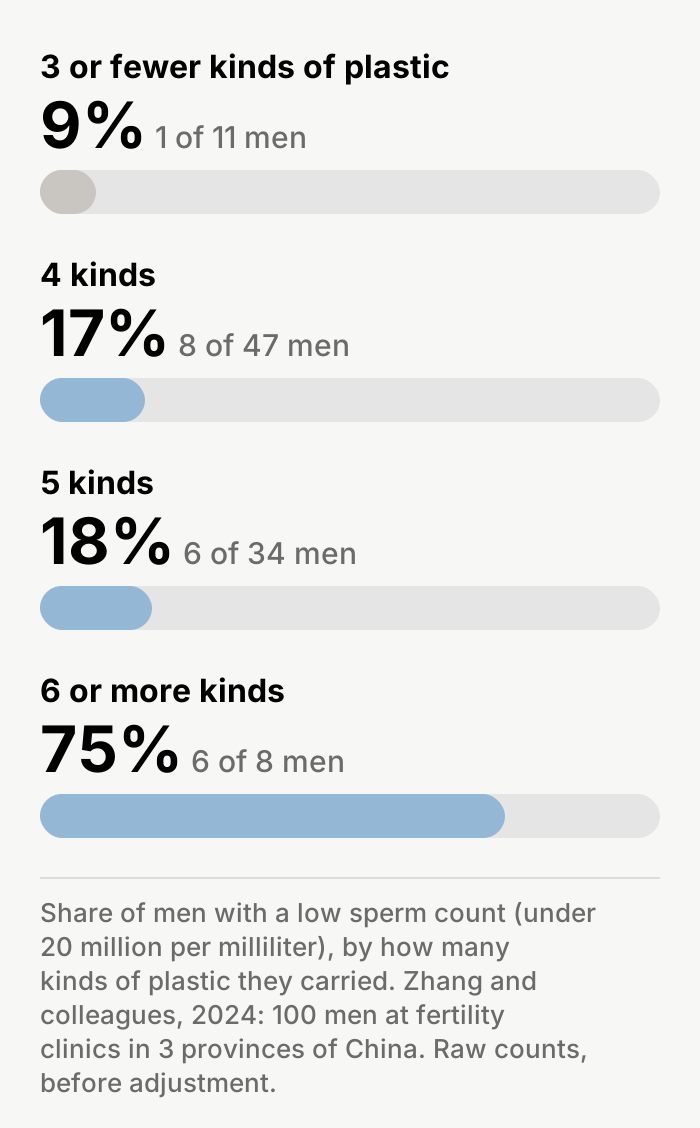
A low count here means under 20 million sperm per milliliter. Of the 8 men with 6 or more kinds of plastic, 6 had a low count. Of the 11 with 3 or fewer kinds, 1 did. Age, weight, smoking, drinking and hospital were allowed for. Each extra kind went with about 3 times the odds of a low count.[1]
One plastic stood out
PTFE, the plastic best known as a non-stick coating, turned up in 55 of the 100 men. Of those 55, 16 had a low count. Of the 45 without it, 5 did. The study measured no cookware, so it cannot say where it came from.[1]
Who had a low sperm count?[1]
Was plastic in human testicles?
23 of 23
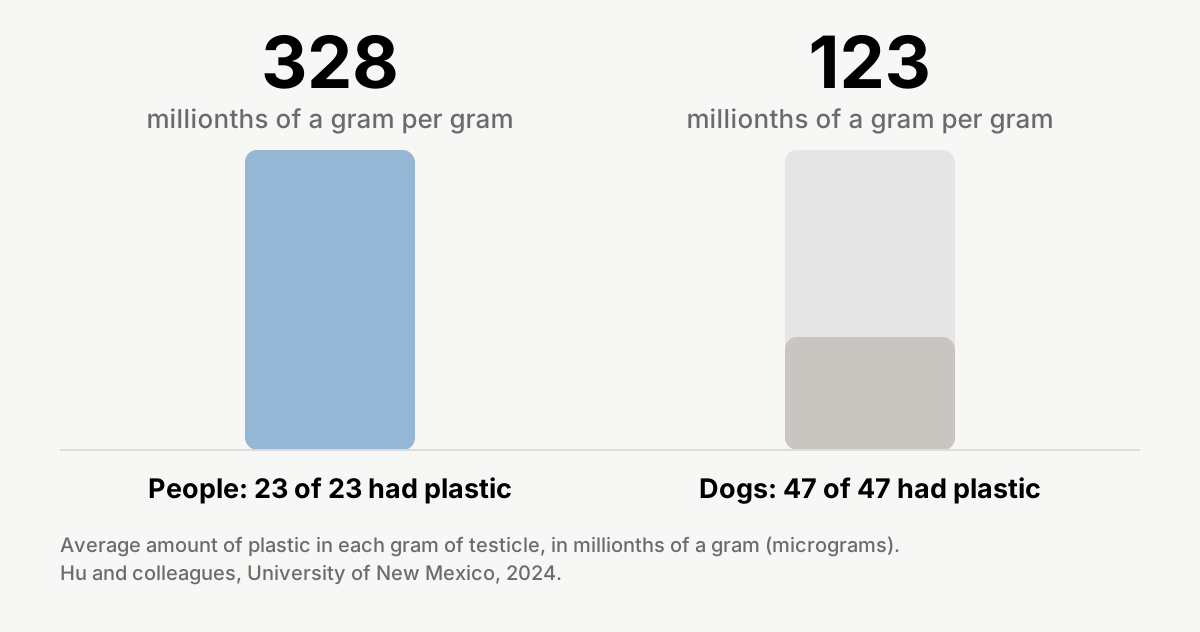
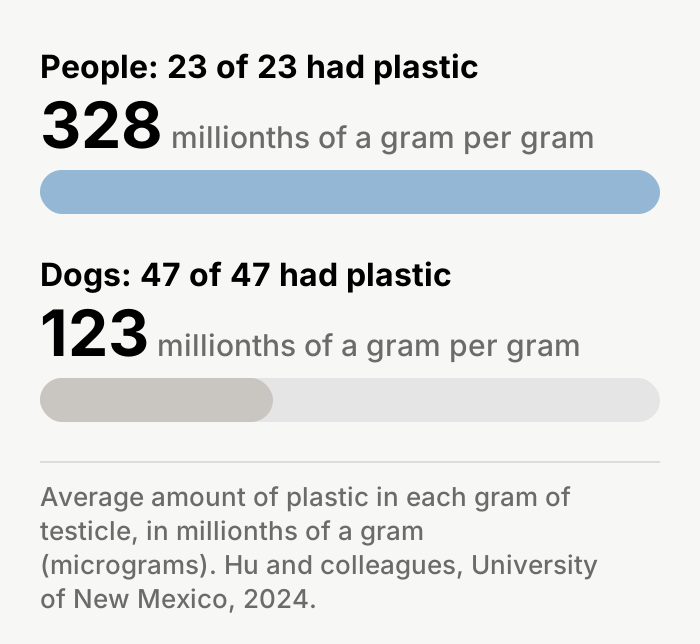
Yes. A team in New Mexico tested 23 human testicles from males aged 16 to 88 who died in 2016. Plastic turned up in 23 of 23. On average, each gram held about 328 micrograms of plastic. A microgram is a millionth of a gram.[2]
Nearly 3 times the dogs' level
The same team tested 47 dog testicles from routine neutering. Dogs share people's homes and pollutants. Plastic turned up in 47 of 47. Human testicles held nearly 3 times as much plastic as the dogs'. In the dogs, more of 3 kinds of plastic went with lighter testicles for their body weight. The human samples had no sperm count.[2]
How much plastic was in the testicles?[2]
Was plastic in placentas?
1,750 placentas
Yes. The placenta is the organ that feeds a baby in the womb. In 2026, a team in China counted the plastic in 1,750 placentas. Babies with more plastic in the placenta were born smaller: lower birth weight, shorter length and smaller head measurements. In every model the abstract reports, the pattern ran one way: more plastic, smaller babies.[7]
An earlier study, behind a paywall
A smaller study in Tehran, Iran, checked 43 placentas after birth. Its short public summary (the abstract) says plastic turned up in 13 of 13 placentas from babies who grew too slowly, and in 3 of the other 30. More plastic went with smaller newborns, though the authors say the pattern was not a straight line. The full paper is behind a paywall, so we couldn't check the details.[3]
What happened when mice drank plastic?
Fewer healthy sperm, less testosterone
A lab in Nanjing ran the test that cannot be run on people. Male mice drank water with tiny plastic particles in it for 180 days. Other mice drank clean water. The plastic left them with fewer living sperm, more misshapen sperm and less testosterone. The water was the only difference. So here, the plastic did it.[8]
Did baby bottles shed plastic?
The count, and the recount
Yes. A team in Dublin followed the World Health Organization's formula steps. Sterilize the new bottle, fill it with 70°C water, shake for 1 minute. In 2020, it reported 1.3 million to 16.2 million bits per liter. In 2022, the same team re-checked bottles with an alcohol rinse. It washes off waxy bits its laser test can mistake for plastic. The count fell to about 100 to 100,000 bits per liter. A lab in Germany tested 7 bottles the same way. It found none of the bottles' own plastic.[4, 5, 6]
The everyday route
This is the one study that caught plastic on its way into a drink. The 4 body studies found it already inside people and dogs. The mice got theirs the same way, in the water. Another lab did the same for plastic and weight gain in mice.[4, 8]
How did they find the plastic?
In China, every glass tube was baked at 500°C for 8 hours to burn off stray plastic. 50 blank tests found none. A laser then named each bit.[1]
In New Mexico, the lab dissolved each piece of testicle and heated the rest into gas. The gas names each plastic. The artery study from Italy used the same test.[2]
What this proves, and what it doesn't
What these studies show
- 100 of 100 men tested in China had plastic in their semen. More kinds went with more low sperm counts.[1]
- Plastic turned up in 23 of 23 human and 47 of 47 dog testicles in New Mexico.[2]
- In 1,750 mother-baby pairs in China, more placenta plastic went with smaller newborns.[7]
- In Tehran, 13 of 13 placentas from babies who grew too slowly held plastic, against 3 of 30 from normal pregnancies. We could read only the abstract; the full paper is paywalled.[3]
- Male mice that drank plastic for 6 months had fewer healthy sperm and less testosterone.[8]
- New baby bottles shed plastic into hot water: 100 to 100,000 bits a liter on the recount.[4, 5]
What these studies did not prove
- That plastic caused the findings in people. Each person and dog was tested once. Those studies show a link, not a cause. Cause was tested in the mice, and there the plastic did it.[1, 2, 8]
- In the men, the link held for sperm per milliliter, not for total sperm or forward swimming.[1]
- In the dogs, sperm counts were mixed. With age counted, no plastic went with a lower count.[2]
- The Tehran study picked its groups by baby size. So part of the link with size is built in. A 2024 review found that evidence too weak for a verdict.[3, 13]
- Where the plastic in people came from. No body study measured a source.[1, 2, 3, 7]
- That every bottle sheds its own plastic. The German lab found none its test can pick up.[6]
Questions readers are asking
Should parents stop sterilizing bottles or using hot water?
No. The World Health Organization advises water of at least 70°C to kill germs that can make babies seriously ill. The Dublin authors did not advise skipping it, and an outside expert said those known germ risks come first.[4, 12]
Can microplastics cause a low sperm count?
In men, the study found a link: more kinds of plastic, more low counts. The authors call for studies that follow men over time to test cause. In mice, that test has been run: plastic in the drinking water left them with fewer healthy sperm and less testosterone.[1, 8]
Do microplastics lower testosterone?
In mice, yes. In Nanjing, male mice that drank plastic in their water for 6 months ended up with less testosterone than mice on clean water. In men, no published study has measured it yet. The human evidence so far is a link: 100 of 100 semen samples from men tested at fertility clinics held plastic, and men carrying more kinds of plastic were more likely to have a low sperm count.[1, 8]
Is 16.2 million bits per liter the real figure?
No. That was the highest 2020 average for one product. The same team's 2022 recount put the levels far lower: about 100 to 100,000 per liter.[4, 5]
Is the New Mexico method disputed?
Yes. Three scientists wrote to the journal in a letter funded by the American Chemistry Council, the US plastics and chemical industry group. They said the paper showed no blank tests. The authors replied that their checks were in an earlier paper and that they will now focus on the 6 plastics they measure best.[9, 10]
About Aelo
Lab-tested on particles down to 0.5 microns (500 nanometers). Aelo's products are not connected to this research.
The technical record
Everything above is the story. Everything below is the paperwork: the exact statistics as published, the study’s own fine print, and the parts only a methods reviewer will want.
The numbers, exactly as published
| 100 of 100 | 281 men qualified, 113 took part (40.2%); semen and urine both tested for plastic in 100; at least 1 kind in each sample for 100 of 100; 3 to 5 kinds in 91 of 100. |
|---|---|
| More kinds, more low counts | Low sperm concentration (under 20 million per mL) by kinds of plastic, unadjusted: 3 or fewer, 1 of 11 (9%); 4, 8 of 47 (17%); 5, 6 of 34 (18%); 6 or more, 6 of 8 (75%); p = 0.001. Per extra kind, adjusted for age, BMI, smoking, alcohol and site: odds ratio 3.22 (95% CI 1.27 to 8.12), p = 0.013; sperm concentration beta −0.18 on a log scale (95% CI −0.35 to −0.01), p = 0.036. The study recorded which plastics were present, not how much, so "more kinds" is the exposure measure throughout. |
| One plastic stood out | Non-stick coating plastic (PTFE) present against absent: low concentration 16 of 55 (29%) against 5 of 45 (11%), p = 0.028, unadjusted; adjusted odds ratio 4.32 (95% CI 1.03 to 18.18), p = 0.046. Adjusted log-scale betas: total sperm number −0.36 (95% CI −0.70 to −0.02), p = 0.036; concentration −0.31 (−0.61 to −0.01), p = 0.041. |
| 23 of 23 | Human range 161.22 to 695.94 µg/g; mean 328.44 µg/g. Samples from the New Mexico Office of the Medical Investigator, stored 7 years, from males who "typically did not experience a natural death". The paper calls them "Twenty-three human testis samples", each with its own sample ID and age; it does not state whether any two came from the same person. |
| Nearly 3 times the dogs' level | Dogs: mean 122.63 µg/g, range 2.36 to 485.77; human against dog p ≤ .001. Polyethylene about 35% of the plastic in people and 36% in dogs. Dog correlations with testicle weight per kg of body weight, unadjusted: PVC r = −0.30, PET r = −0.33, styrene-butadiene rubber r = −0.31, each p ≤ .05. PVC against dog sperm count: r = −0.14, not significant. |
| Fewer healthy sperm, less testosterone | Jin 2022: 7 groups of 15 male mice; polystyrene particles at 100 or 1,000 µg/L in drinking water for 180 days; lower sperm viability, higher sperm abnormality rate and lower serum testosterone, LH and FSH than controls. One lab, one plastic, set doses. |
| 1,750 placentas | Shen 2026, open access, abstract only: 1,750 pairs, births 2022 to 2024, a cross-sectional analysis inside a larger cohort; particles counted per 10 g of placenta by laser infrared imaging; medians PVC 7.0, PP 5.0, PBS 4.0, PET 3.0. Total plastic against birth weight −107.7 g (95% CI −138.87 to −76.49), p < 0.001, adjusted; the unit behind that estimate is not stated in the abstract. Mixture models: birth weight −117.7 g (−155.3 to −80.1) and −100.9 g (−146.2 to −55.5); length −0.89 cm (−1.20 to −0.58) and −0.96 cm (−1.34 to −0.58); head circumference also lower; the BKMR model was monotonic for weight, length and head circumference; stronger in boys (p for interaction 0.04). |
| An earlier study, behind a paywall | Amereh 2022, abstract only; the full paper is paywalled. 43 women in Tehran: plastic in 13 of 13 placentas from growth-restricted pregnancies, at 2 to 38 particles each, and in 3 of 30 normal pregnancies, the rest below the detection limit (the abstract's count; see the fine print on the Tehran placentas). Correlations with placenta plastic count: birth weight r = −0.82 (p < 0.001); length r = −0.56 (p < 0.001); head circumference r = −0.50 (p = 0.001); 1-minute Apgar score r = −0.75 (p < 0.001). Whether the r values cover all 43 babies or only the 13 is not stated in the abstract. |
| The count, and the recount | 2020 averages at 70°C after sterilizing, 5 bottles per product: 1,314,000 to 16,224,000 particles per liter across 8 bottle bodies; glass-beaker control 170 per liter; hotter water gave higher counts. 2022 recount: about 100 to 100,000 per liter, by brand and length of use; one sentence, no bottle tables. Gerhard 2022 (Münster): 1 of 7 bottles above the detection limit, particles more likely contamination than bottle plastic. |
The fine print: the men in China
Of 281 men who qualified, 113 took part, a response rate of 40.2%. Semen and urine were both tested for plastic in 100 of them, and 100 of those 100 carried at least 1 kind in each. Most carried 3 to 5 kinds at once: 91 of 100. The plastic bits measured 1.2 to 20 micrometers across.[1]
Per extra kind of plastic, adjusted for age, BMI, smoking, alcohol and site, only sperm concentration held: beta −0.18 on a log scale (95% CI −0.35 to −0.01), p = 0.036. Total sperm number: beta −0.19 (−0.38 to 0.006), p = 0.067. Forward (progressive) motility: beta −0.08 (−0.23 to 0.07).[1]
Non-stick coating plastic (PTFE), unadjusted: 28 of 55 men carrying it had too few forward-swimming sperm, against 14 of 45 without it (51% against 31%), p = 0.046. Adjusted, the odds ratio for low forward swimming was 2.29 (0.96 to 5.49) and not significant. The authors say there is no direct evidence tying the PTFE to cookware.[1]
The paper's abstract prints effect sizes per extra kind of plastic for total count, concentration and forward movement (β −15.4, −7.2 and −8.3), a pattern-analysis odds ratio (3.5) and PTFE concentration averages that appear nowhere in the Results, figures or 12 supplementary tables, and the body reports different numbers. We use the body and supplement. The abstract and text also reverse the PTFE forward-motility averages against Table S3. Our re-check of the PubMed abstract on 2026-10-05 confirms those abstract-only figures are still there.[1]
Polystyrene turned up in 100 of 100 men tested, so its effect could not be tested. The study recorded which plastics were present, not how much; it had no fertile men for comparison; and fewer than half of eligible men took part. No source was measured. The page's "men carrying the most kinds of plastic" wording follows this: the study counted kinds, not amounts.[1]
The fine print: the New Mexico testicles and the method dispute
Human samples: 23 testicles from the New Mexico Office of the Medical Investigator, collected in 2016, from males aged 16 to 88 who "typically did not experience a natural death", in the authors' words. The samples had been stored for 7 years and were due to be thrown away. The paper describes them as "Twenty-three human testis samples" and plots each as "a unique human sample ID" with its own age; it does not say whether any two samples came from one person. Range 161.22 to 695.94 µg/g; mean 328.44 µg/g. Dogs: 47 testicles; range 2.36 to 485.77 µg/g; mean 122.63 µg/g. Human levels were higher, p ≤ .001.[2]
Dog correlations, unadjusted, 36 tests with no correction for multiple testing: testicle weight per kg of body weight with PVC r = −0.30, PET r = −0.33 and SBR r = −0.31; sperm count with PC r = −0.30, ABS r = −0.35 and polyurethane r = +0.34. PVC against sperm count was r = −0.14 and not significant, so the page ties PVC to testicle weight, not to sperm count. No plastic was linked to epididymis weight. Polyethylene, the main plastic, showed no link with any measure. The text mentions the two negative sperm-count results and not the positive one. The authors write that "a decreased testis weight is indicative of reduced spermatogenesis", citing Creasy 2003.[2]
Adjusted for the dog's age (the numbers are in Supplementary Table 1, which we could not obtain): PVC, PET, PC and PS went with lower dog testicle weight, and age, N66 and ABS with higher. PC and PS are not on the authors' later high-confidence list. For dog epididymis weight, PVC went with lower weight. For dog sperm count, age went with lower counts and PMMA with higher counts; no plastic went with lower counts.[2]
The paper reports no contamination controls of its own; the authors point to their 2024 placenta paper. The comment by Uppu, Peijnenburg and Hays was funded by the American Chemistry Council; it said there was "no way of knowing if false positives exist" and named 2 plastics as hard to measure this way, both among the 3 tied to the dog result. In reply, the authors named 6 plastics they measure with enough confidence: polyethylene, polypropylene, PVC, nylon, styrene-butadiene rubber and PET. PC, ABS, polyurethane and PMMA are not among them. All 3 plastics tied to lighter dog testicles in the simple comparison are on that list. The same reply calls polyethylene, the top plastic in both species here, "challenging" to measure, because body fats can interfere and create false positives; the authors chose their digestion method to limit this.[2, 9, 10]
6 of the paper's 10 authors also wrote the Nihart 2025 brain study, which uses the same method and tissue from the same medical examiner's office; that study faces the same fat-interference question, covered in our article on plastic, the brain and memory. The university's press release differs from the paper on the human average (329.44 against 328.44), on which plastic went with dog sperm counts and on the donors' ages; we use the paper.[2, 11]
The fine print: the 2026 placenta study
Shen 2026 (Ecotoxicology and Environmental Safety): 1,750 mother-infant pairs from a large cohort in China, births 2022 to 2024, described by the authors as a cross-sectional analysis. Plastic was counted per 10 g of placenta by laser direct infrared imaging, which sees particles above roughly 10 to 20 microns and misses smaller ones; medians PVC 7.0, PP 5.0, PBS 4.0, PET 3.0 particles per 10 g. Total plastic against birth weight: −107.7 g (95% CI −138.87 to −76.49), p < 0.001, in an adjusted model whose covariates the abstract does not list; the abstract also does not state the unit of that estimate (per particle, per quartile or per log unit), so the page prints no grams in the story. Mixture models: birth weight −117.7 g (−155.3 to −80.1) and −100.9 g (−146.2 to −55.5); length −0.89 cm (−1.20 to −0.58) and −0.96 cm (−1.34 to −0.58); head circumference lower; the BKMR model was monotonic for all three; the link was stronger in boys (p for interaction 0.04). Read at abstract level; the journal is open access and the full text is still to be read. PBS, a biodegradable plastic, ranking so high is unusual for human tissue and may be a library-matching issue. The same cohort appears to report other outcomes in separate 2025 and 2026 papers, so those are not independent replications of this one.[7]
The fine print: the Tehran placentas, read from the abstract
The full paper is paywalled, and no open copy exists. We read the published abstract, the highlights and the figure images; the figure captions were not available. Our re-checks of the PubMed abstract on 2026-10-05 and 2026-10-12 match the figures printed here.[3]
The abstract says plastic was below the detection limit in the normal pregnancies except for 3 of 30, and the page prints that count as the abstract's. The paper's Figure 4 appears to show a different number, and two later summaries agree with the figure, not the abstract. Without the paywalled full paper, we cannot settle which is right.[3]
Up to 64% of the bits were smaller than 10 microns; a human hair is about 50 to 100 microns wide. Most were polyethylene and polystyrene, the plastics in shopping bags and foam cups.[3]
The abstract does not say whether the correlations cover all 43 babies or only the 13, whether results were adjusted for the mother's age, weight, smoking or weeks of pregnancy, or what blanks and detection limits were used. The authors describe the pattern as nonlinear, so for this study the page says "more plastic went with smaller newborns"; the lines "more plastic, smaller babies" and "babies with more plastic in the placenta were born smaller" are used only for Shen 2026, where the dose pattern ran in one direction. Because the groups were split by baby size, the link with size is partly built into the design.[3]
The 2024 rapid systematic review by Chartres and colleagues rated birth size and pregnancy length "unclassifiable" because the evidence was of low and very low quality; Amereh 2022 is one of its 3 human studies. One Amereh author works for Veolia North America, a water company; the paper declares no competing interests.[3, 13]
The fine print: the baby bottles, the 2020 counts and the recount
2020 averages at 70°C after sterilizing, 5 bottles per product: 1,314,000 to 16,224,000 particles per liter across the 8 bottle bodies, and 69,000 to 2,532,000 for add-on parts. 16.2 million is one product's 5-bottle average. The glass-beaker control averaged 170 per liter. The 10 products tested held about 69% of online sales across 48 countries and regions, and about 8 in 10 bottles sold there were made fully or partly of the plastic tested.[4]
Temperature test, bottle 1, no sterilizing: 625,000 at 25°C; 3,139,000 at 40°C; 6,130,000 at 70°C; 54,712,000 at 95°C, per liter. Sterilizing raised the counts by 34.7%, 84.2% and 72.1% for 3 products; the manuscript gives no p-value.[4]
Only 4 spots on each filter, 1.5136 of 227 square millimeters, were counted and scaled up. Recovery of the spiked test particles was 94.9%, and a blind count by Keyence matched the lab's. Neither check could catch additive specks read as plastic.[4]
In 2022 the same team showed that slip additives such as oleamide and erucic acid match polypropylene closely in the signal band the 2020 paper used. An alcohol rinse cut bottle levels from over 1 million to around 100 to 100,000 per liter. The recount is one sentence; no bottle data tables were published with it. The Münster lab (Gerhard 2022) tested 7 bottles and found 1 above the detection limit, with particles more likely contamination than bottle plastic.[5, 6]
The paper's per-baby daily estimates are a model built on online sales data, made before the recount, and we do not print them. No babies were tested. We read the authors' accepted manuscript and the publisher's open supplement; the paywalled published version was not read.[4]
The fine print: the mouse experiment
Jin 2022 (Nanjing University, Particle and Fibre Toxicology): 7 groups of 15 male mice; polystyrene particles in drinking water at 100 or 1,000 µg/L for 180 days; lower sperm viability, higher sperm abnormality and lower serum testosterone, LH and FSH than mice on clean water. It is the one controlled experiment on this page, so it is the one place the page uses causal verbs. It is cited through the explainer's fact sheet; the same lab's brain study used mice from the same batch, so the two Jin papers are not independent. The particles are one plastic at set doses; the human tissue here held mostly polyethylene.[2, 8]
The fine print: funding, conflicts and how we checked
Zhang 2024: public research funds in Shanghai and China; the authors declare no competing interests. Hu 2024: US National Institutes of Health grants; no conflicts declared. Amereh 2022: funding not stated in the parts we could read; no competing interests declared. Li 2020: Enterprise Ireland, Science Foundation Ireland, a Trinity scholarship and the China Scholarship Council; no competing interests declared. Shen 2026: funding and competing interests are not in the abstract we read.[1, 2, 3, 4, 7]
Read in full: Zhang 2024 and its supplement; Hu 2024, the comment and the reply; the Li 2020 accepted manuscript, supplement and source data; Li 2022. Read at abstract level: Amereh 2022 (paywalled), Gerhard 2022 (paywalled) and Shen 2026 (open access; full text not yet read). No paywall or bot check was bypassed. The key numbers were re-checked against the PubMed records on 2026-10-05.[1, 2, 3, 4]
The fine print: about this version
This version opens with the share of samples that held plastic in the semen and testicle studies, stated as a percentage; the exact counts (100 of 100, 23 of 23) stay on the page in the Short Summary, the body and these sections. The limits of the evidence are stated once, in the boundary block. The mouse experiment has its own section, so the body runs from what was found in people, to the link with sperm counts, to the controlled test in mice, then to placentas and the bottle as the everyday route. The placenta finding now leads with Shen 2026, a study of 1,750 placentas that is free to read (open access), read at abstract level. The 2022 Tehran study (Amereh 2022) follows it, briefly, labelled wherever it appears as read from the abstract only, because the full paper is paywalled; its counts (13 of 13 and, from the abstract, 3 of 30) stay in the Short Summary, the body and these sections. The per-baby exposure model, the three-week bottle test and the kettle result stay out of the story. The 2020 hot-water chart left the story too, because the same team's 2022 recount revised that method; its numbers are in the baby-bottle record above. Every figure that left the story is printed in these sections, from the papers' own text and tables.
Sources
- Zhang C, Zhang G, Sun K, et al. Association of mixed exposure to microplastics with sperm dysfunction: a multi-site study in China. eBioMedicine. 2024;108:105369. doi:10.1016/j.ebiom.2024.105369. PMID 39342804. PMCID PMC11663775. Association of mixed exposure to microplastics with sperm dysfunction: a multi-site study in China
- Hu CJ, Garcia MA, Nihart A, et al. Microplastic presence in dog and human testis and its potential association with sperm count and weights of testis and epididymis. Toxicol Sci. 2024;200(2):235-240. doi:10.1093/toxsci/kfae060. PMID 38745431. PMCID PMC11285152. Microplastic presence in dog and human testis and its potential association with sperm count and weights of testis and epididymis
- Amereh F, Amjadi N, Mohseni-Bandpei A, et al. Placental plastics in young women from general population correlate with reduced foetal growth in IUGR pregnancies. Environ Pollut. 2022;314:120174. doi:10.1016/j.envpol.2022.120174. PMID 36113646. Paywalled; abstract, highlights and figure images only. Placental plastics in young women from general population correlate with reduced foetal growth in IUGR pregnancies
- Li D, Shi Y, Yang L, et al. Microplastic release from the degradation of polypropylene feeding bottles during infant formula preparation. Nat Food. 2020;1(11):746-754. doi:10.1038/s43016-020-00171-y. PMID 37128027. Accepted manuscript and open supplement read. Microplastic release from the degradation of polypropylene feeding bottles during infant formula preparation
- Li D, Sheerin ED, Shi Y, et al. Alcohol pretreatment to eliminate the interference of micro additive particles in the identification of microplastics using Raman spectroscopy. Environ Sci Technol. 2022;56(17):12158-12168. doi:10.1021/acs.est.2c01551. PMID 36006854. PMCID PMC9454250. The same team's recount of baby-bottle levels. Alcohol Pretreatment to Eliminate the Interference of Micro Additive Particles in the Identification of Microplastics Using Raman Spectroscopy
- Gerhard MN, Schymanski D, Ebner I, et al. Can the presence of additives result in false positive errors for microplastics in infant feeding bottles? Food Addit Contam Part A. 2022;39(1):185-197. doi:10.1080/19440049.2021.1989498. PMID 34732109. Abstract only. Can the presence of additives result in false positive errors for microplastics in infant feeding bottles?
- Shen Y, Ning Y, Chen F, et al. Impact of placental microplastics on birth anthropometrics: A cross-sectional study. Ecotoxicol Environ Saf. 2026;309:119572. doi:10.1016/j.ecoenv.2025.119572. PMID 41499815. Open access; read at abstract level; the lead placenta study. Impact of placental microplastics on birth anthropometrics: A cross-sectional study
- Jin H, Yan M, Pan C, et al. Chronic exposure to polystyrene microplastics induced male reproductive toxicity and decreased testosterone levels via the LH-mediated LHR/cAMP/PKA/StAR pathway. Part Fibre Toxicol. 2022;19:13. doi:10.1186/s12989-022-00453-2. PMID 35177090. The controlled mouse experiment on this page, read through the explainer's fact sheet. Chronic exposure to polystyrene microplastics induced male reproductive toxicity and decreased testosterone levels via the LH-mediated LHR/cAMP/PKA/StAR pathway
- Uppu RM, Peijnenburg W, Hays SM. Comment on: "Microplastic presence in dog and human testis and its potential association with sperm count and weights of testis and epididymis". Toxicol Sci. 2025;206(2):456-457. doi:10.1093/toxsci/kfae136. PMID 39475449. Published comment on Hu 2024, funded by the American Chemistry Council. Comment on: "Microplastic presence in dog and human testis and its potential association with sperm count and weights of testis and epididymis"
- Hu CJ, Garcia MA, Nihart A, et al. Response to comment on: "Microplastic presence in dog and human testis and its potential association with sperm count and weights of testis and epididymis". Toxicol Sci. 2025;206(2):458-459. doi:10.1093/toxsci/kfae137. PMID 39432568. The authors' reply to the comment. Response to comment on: "Microplastic presence in dog and human testis and its potential association with sperm count and weights of testis and epididymis"
- Haederle M. UNM Researchers Find Microplastics in Canine and Human Testicular Tissue. University of New Mexico Health Sciences Newsroom, 15 May 2024. The university's press release on Hu 2024; it differs from the paper on the human average, the dog sperm-count result and the donors' ages. UNM Researchers Find Microplastics in Canine and Human Testicular Tissue
- Science Media Centre. Expert reaction to study looking at microplastics and infant feeding bottles. 19 October 2020. Comments from Dr Fay Couceiro and Prof Oliver Jones. expert reaction to study looking at microplastics and infant feeding bottles
- Chartres N, Cooper CB, Bland G, et al. Effects of microplastic exposure on human digestive, reproductive, and respiratory health: a rapid systematic review. Environ Sci Technol. 2024;58(52):22843-22864. doi:10.1021/acs.est.3c09524. PMID 39692326. PMCID PMC11697325. Background review, not a source for these studies' findings. Effects of Microplastic Exposure on Human Digestive, Reproductive, and Respiratory Health: A Rapid Systematic Review